Saturday, June 7, 2025

Bulletin #44 : 6 June 2025

President Kelly

Whilst missing in action last week to attend his father's 100th birthday (not his 95th as previously mis-reported - and I didn't even cop a fine!) President Kelly returned to a welcome fit for a hero! 

Guest Speaker - Dr Terry Humphries - Hydrogen Storage

Wayne Duke introduced Terry who he met at Levy Stapleton's first birthday party, Terry being good friends with Jaclyn and Jackson. One thing led to another resulting in Terry being invited to speak to us today.

Terry is a senior research fellow at Curtin university and part of the Hydrogen Storage Research Group (HSRG) which is a world-class research group in the field of hydrogen and energy storage, focusing on innovative solutions for hydrogen storage and its applications.

Since its establishment the group has been at the forefront of research, addressing industry challenges and advancing technologies for a sustainable energy future. Their work spans a wide range of areas, including the development of solid-state hydrogen carriers and export materials, thermochemical energy storage systems and next generation solid state batteries. The HSRG also collaborates with international partners and industries ensuring their research addresses real-world needs and contributes to the global hydrogen economy.

Terry loves to give talks to different groups creating awareness in communities of the HSRG  and began his presentation with an acknowledgment of Country.

The HSRG is led by Professor Craig Buckley for the last 20 years and the group consists of about eight or nine staff and eight or nine PhD students which increase and decrease as the year goes along. The research would not be possible without the various funding agencies and industrial partners needed to run the project.


Hydrogen economy is a necessary transition that is needed to make way from fossil fuels. 

It's not just the fact that fossil fuels are going to run out and the fact that we can't keep up with production or with the ongoing demand for energy that we need today. It is mainly pushed by climate change as well. We are all seeing the issues whether it be the forest fires, bushfires, floods that we are seeing in NSW and Qld and that's all to do with climate change, so we need to be able to build up our renewable energy and hopefully everyone is getting on board with this.

We need to come up with a way to actually store this energy because we need it for applications such as phones, watches, and cars where we tend to use batteries because it's nice and simple. 

However we need to start thinking about large-scale applications where batteries aren't so good, they're very expensive and not got much energy density, so if we are going to power a city or a mining site then large-scale is where we need to go, especially if we have to store energy for seasonal storage.

Not many people are aware of hydrogen at the moment, yet it's been in many country manifestos since 2019.

Hydrogen's extremely low density and small molecular size make it difficult to store and transport efficiently, especially compared to fossil fuels.  

However, hydrogen is the smallest and lightest element; 1L of gasoline weighs about 0.74kg, while 1L of hydrogen at standard temperature and pressure weighs only 0.009kg. Storing large quantities without massive infrastructure is a significant challenge.

Hydrogen is categorized by production method: grey/black/brown (from fossil fuels), blue (from fossil fuels with carbon capture and storage or utilization), green (from renewables via electrolysis), and white (naturally occurring, geologically sourced hydrogen). The transition to a hydrogen economy involves moving from fossil-based hydrogen to green hydrogen, with blue hydrogen as a transitional option and white hydrogen as a potential supplementary source.

Green hydrogen is the ultimate goal for a sustainable hydrogen economy, but blue and white hydrogen may play important transitional or supplementary roles. 

The hydrogen economy requires coordinated advancements in four main areas: production, utilization, distribution, and storage. Each area presents unique challenges and opportunities. Production can use grid energy and electrolysers; utilization includes vehicles, synthetic fuels, ammonia, and green steel; distribution and storage are technically challenging and are the main focus of the research group.  

Australia has significant potential for hydrogen production, especially using solar photovoltaics in coastal areas. Maps show that the best regions for hydrogen production are near ports, facilitating export. Projected hydrogen demand is 2-9 million tonnes by 2030 and 20-230 million tonnes by 2050. Many energy-deficient countries are seeking to import hydrogen, and Australia is seen as a reliable supplier.  

The four main export methods are liquid hydrogen (requires storage at -253°C, very expensive ships); ammonia (already widely shipped, but toxic and requires high temperatures for hydrogen release); liquid organic hydrogen carriers (recyclable, but need heating to 200°C to release hydrogen); and sodium borohydride (can be shipped on standard cargo ships, potentially as low as $4.40/kg, and is safe and stable). 

The group is developing a process to produce sodium borohydride using green electricity, ship it globally, and release hydrogen by adding water at the destination. The byproduct, sodium borate, is shipped back for recycling in Australia. The project received $8 million in government funding in 2023. Sodium borohydride has been used in industry since the 1950s and contains 10.7% hydrogen by weight; when reacted with water, the effective hydrogen yield is 21.4%. Electrochemical regeneration is being developed to recycle sodium borate back to sodium borohydride without the need for electrolysers. The main challenges are scaling up production, perfecting recycling, and ensuring the process is economically viable. 

Hydrogen vehicles require a network of refueling stations for practical use across regions. Heavy haulage trucks, though only 4% of vehicles, contribute 27% of transport emissions. Replacing diesel with hydrogen in these trucks could reduce CO2 emissions by 57%. There is high demand for hydrogen vehicles, but supply is limited and infrastructure is lacking. 

Hydrogen is invisible and odorless, making leak detection critical for safety and exploration. The group is developing Raman scattering-based sensors for airborne and pipeline detection. White hydrogen, naturally occurring, was recently discovered in France (92 million tonnes in Moselle, March 2025), and similar reserves may exist in Australia due to geological processes. The sensors can be mounted on planes or used in plants and pipelines to detect leaks or natural emissions.

Hydrogen can cause embrittlement in metals and permeate non-metals, leading to potential pipeline failure. The group is testing materials and developing composite solutions, such as pipelines with liners and metal cores, to balance permeability and resistance to embrittlement. Permeability rigs and other testing setups are being used to evaluate materials.

 Terry explained that there is reseach being carried out on solid-state batteries as a safer alternvie to liquid electrolyte batteries which can catch fire in accidents and discussed the overall prospects and challenges for the hydrogen economy  covering cost efficiency recycling and public perspectives. However according to the 2024 Australian strategy, Australia has the most hydrogen projects globally, though progress is slow. The US (especially California) and China are also highlighted as active producers, with California having hydrogen refueling sites at petrol stations. Main production areas are those with abundant renewable energy.

To date there have been no known safety incidents with hydrogen-fueled vehicleds. Atco's hydrogen cars in Jandakot were cited, with detailed safety features such as pressure and temperature sensors, safety valves, and the behavior of hydrogen in case of a tank rupture (hydrogen rises and burns quickly, reducing risk).  

Hydrogen storage and usage have historically experienced cycles of progress and decline, often driven by external factors such as oil prices. The current momentum is driven by climate change concerns and has lasted about 10 years, with significant funding and global investment. However, progress is still considered slow, and more sustained effort is needed to avoid repeating past failures.

A full presentation can be found on the Club website.

Directors' Reports and Member Announcements

Veronica :

  • Membership meeting next week after breakfast
  • Launch of the Global Hand Charity major fundraising event "Offtraq" take a flyer and support this event.
  • The funeral of Dr Alan Eggleston, long time member of this club will be held Saturday 7 June at Christchurch Grammar 10am.

David R:

  • Gala luncheon to celebrate our Changeover on Friday 27 June. Details in the Events page (scroll down after reading this) or book at trybooking.com/DBENN 

Wayne M: 

  • Last weekend when Kelly was MIA, saw the publishing of a double volume of the 'Gillen Dynasty' which Kelly had put together to celebrate his father's 100 birthday. As well the number of invitees doubled on the day - a testimony to his father's reputation in the community.

Lew T:

  • 34 years ago Reg Willis, a member of our Club was appointed District Governor of D9465, his theme for that year was 'Simply the Best' and was most fitting for Reg's dedication and commitment to Rotary. This year another member of our club - Veronica Lawrance - has been nominated as District Governor of D9423 - the combined Districts of 9465 and 9455 - now covering the whole of Western Australia. 
  • Please come and show Mill Point support as she takes up the mantle of DG on Saturday 14 June at the Leederville Function Centre 6.00pm, $55 pp two course meal, dress Cocktail. Book at https://www.trybooking.com/DBDYO

Kelly:

  • In April the Council of Legislation (CoL) met (Governing body for Rotary International). 86 enactments were transmitted to the CoL who adopted 31 recommendations and rejected 37. The Mill Point RC Board have met and reviewed the proposals finding no direct impact on the club and so will vote on these recommendations in the positive. A copy of the report (37 pages) will be uploaded to the Club's website page in the Member's only section. 

One Fine(s) Day...

  • Soccer fans and has-beens who saw the goal last night Australia 1: Japan 0. 
  • End Of Year (EOY) tragics who hit the sales and now have heaps of stuff they don't know what to do with.
  • BoM says from June to August days and nights will be warmer and wetter in WA, so those who've given up or tossed their snorkels and flippers away - cough up your dollars! 
  • Telstra supporters now that Telstra has been caught colluding with Starlink to provide regional service they were already supposed to be providing!
  • Fishermen and women for another "Doomsday" oarfish otherwise known as the 'King of Herring' found on a beach in Tassie by dog-walkers. Can grow up to 8m long and lives in depths of 150-800m deep.
  • The incoming DG before she spends all her cash on 'chicken dinners' visiting other clubs! 

Winner of Heads and Tails

President Kelly took up the reigns as the weekly 'Tosser' throwing 2 x Heads, 2 x Tails, a Head & Tail and finally 2 Tails which saw newly inducted Bassem take out the wine of the week. Doesn't he look happy! 

Attendance

36 attendees in all, including guest speaker Dr Terry Humphries, 3rd time visitor and prospective member Diane Allen (who will be inducted next week), and visitors Carole and Shaun O'Brien.

Saturday, May 31, 2025

Bulletin #43

President Missing In Action

In the absence of President Kelly who was busy boogy-ing at his dad's 90th birthday, Past President Tricia Smith held court to thunderous applause!

Our Fabulous Unsung Heroes!

Herliana Gunaway and Thiyagarajan Renganathan (Rajan)

It is an honour to nominate Herliana Gunawan and husband Rajan Renganathan for the Unsung Hero Award in recognition of her exceptional dedication and selfless service to the community through her volunteer work at Seeds of Hope Services Inc., located in the City of Perth. Herliana's and Rajan’s unwavering commitment to supporting those in need embodies the true spirit of compassion, resilience, and generosity.

For several years since July 2020, Herliana and Rajan have been a cornerstone of Seeds of Hope Services Inc., dedicating countless hours to aiding marginalized individuals and families experiencing homelessness. Whether it is cooking and distributing food each week for up to 150 homeless and needy individuals, offering emotional support, or organizing community outreach programs, they consistently go above and beyond to ensure that the most vulnerable members of our society receive the help they deserve.

Their ability to connect with people from all walks of life and offer them hope and encouragement is truly inspiring. They work tirelessly behind the scenes, often without recognition, to make a meaningful impact on the lives of those who are struggling. Their positive attitude, strong work ethic, and compassionate heart have earned them the respect and admiration of both their peers and the individuals they serve.

In a world where acts of kindness often go unnoticed, They exemplify what it means to be an unsung hero. Their humility, dedication, and relentless pursuit of making a difference make them deserving recipients of this award. By honoring their contributions, we not only recognize their efforts but also inspire others to follow in their footsteps.

Other family members, including her daughter Rani and mother are also involved in the charity. Their daughter Rani helps out after school on Monday afternoon distributing food at the city.  

Mike Harrison  Manning Men’s Shed


The Manning Men’s Shed offers a few programs for men and women in the community. These programs are designed to help with mental health and have been very effective in addressing levels of depression, social anxiety, and loneliness.

We also get approached by schools in the local area who have children who don’t fit into the typical academic environment.

Typically, these children are autistic or on the spectrum. We’ve been running this program for a few years now, and each year, Mike has taken the lead in caring for the young teenage males who come along.

When these young men first join, they are usually non-verbal and rather insular. Mike takes them under his wing and gets them to do simple things like sanding, nailing, and putting in or taking out screws. This repetitive behaviour seems to appeal to people on the autism spectrum, and it’s amazing to see the transformation that takes place in these young teenage boys.

After a few weeks, they really come out of themselves. Soon, they’re chatting with other men in the shed and taking on new projects to be repaired, all under the watchful eye of Mike.

In the end, Mike just stands back and lets them do their thing. I recently heard that of the two boys who recently attended, one of them has gotten a job, and the other is on the shortlist to start working as well. At the end of the program, we get them to make a little pencil case and we 3D print their names on it. They take these back to school and show them to the other students.

The students who were previously hesitant to join the program now see what they can do at the shed and there at least a dozen students who would now like to join the program.

There are a few things we do at the Shed that I’m very proud of, but the program that I am most proud of is the one that Mike runs. Mike Harrison is an outstanding individual and a very worthy candidate for the unsung hero Award.

Enda Fahy CEO of Southcare on behalf of Sally Marks, Southcare volunteer

It is a great pleasure to honour City of South Perth resident and long-time volunteer Sally Marks, whose quiet yet powerful leadership has made a lasting impact on our community.

Since 2022, Sally has served as the volunteer ambassador of Southcare’s weekly Knitting Circle - a welcoming space where creativity and connection flourish. Through her warmth, skill, and tireless dedication, Sally has transformed this group into a vibrant hub of social interaction, supporting dozens of people of all ages and abilities. Her work directly tackles the growing issue of social isolation, particularly among older Australians, by fostering meaningful connections, reducing loneliness, and promoting mental well-being.

As Southcare’s first Community Ambassador, Sally leads by example - bringing Southcare’s vision of an engaged, supported community to life, one stitch at a time. From complete beginners to seasoned crafters, all are welcomed into a safe, inclusive space where stories are shared, friendships are formed, and purpose is rediscovered.

Beyond her weekly sessions, Sally has championed projects with real impact. She led the group’s contribution to the Purple Road project, raising awareness of elder abuse through hundreds of hand-crafted purple flowers displayed at Parliament House. She coordinated the creation of knitted poppies for a moving Remembrance Day tribute at the Royal Perth Golf Club, and her group crafted beanies for the Soroptimist “Beanies Made with Love” campaign to support Perth’s homeless community.

Sally Marks embodies the Southcare values of Quality, Respect, Integrity, Cooperation and Empathy. Her actions may be quiet, but their ripple effect is profound.

Today, we proudly celebrate Sally as an Unsung Hero - a woman whose compassion, creativity and community spirit continue to enrich lives, one loop, one laugh, and one loving gesture at a time.
 
Congratulations to each of these worthy recipients!
 

Fine(s) and Dandy!

Our little ray of sunshine and joy (Burnett) dished the dirt when describing the deeds of the day...

Past President Tricia was first for cutting Joy's fines session short and also for interrupting whilst she was eating her brekkie...

1.   Top of th list – Lyn Metcalf…welcome back! Now the last time you drove across the Nullarbor, you copped a speeding ticket, this time it was a windscreen, that’s a bit more expensive than the speeding ticket, so I let's grab a dollar before that lovely Bluey comes in - just in case

2.   Anyone NOT wearing Stripes or checks!

Winner of Heads and Tails

Visitor John Marks took out the grog with an excellent win and a huge smile - well done John and thanks to Lyn and Margaret Metcalf for their kind donation of the wine each week.

Attendance

36 attendees in all, including heroes and heroines Herliana Gunaway, Thiyagarajan Renganathan, Mike Harrison, and Sally Marks; visitors Anton Nazzer, Enda Fahy, Graham Rennie, Mandy Sneeuwjagt, John Grohovaz, Christine Tanaka, Mark Jones,  Rani Gunawa, and Jonathan Marks.

Friday, May 23, 2025

Bulletin #42 23 May 2025

Presidential Welcome

After a rousing introduction by Sargeant Mike Collet, President Kelly welcomed Rotarians and visitors alike and opened the meeting to thunderous applause!

Guest Speaker : Renewable Energy Infrastructure Challenges and Grid Stability in Australia - Ian Kremmer.

Ian Kremmer is a qualified civil structural engineer with 45 years of experience, and provided an overview of the current and planned renewable energy projects in Australia, highlighting their scale, costs, and types—including transmission, generation, and storage projects. He emphasized the involvement of the Australian Market Operator (AEMO) in managing the transition and referenced the recent merger of his consultancy, E3 Advisory, with Argo PLC Consulting Group, which specializes in strategic policy and implementation in the renewable energy transition.

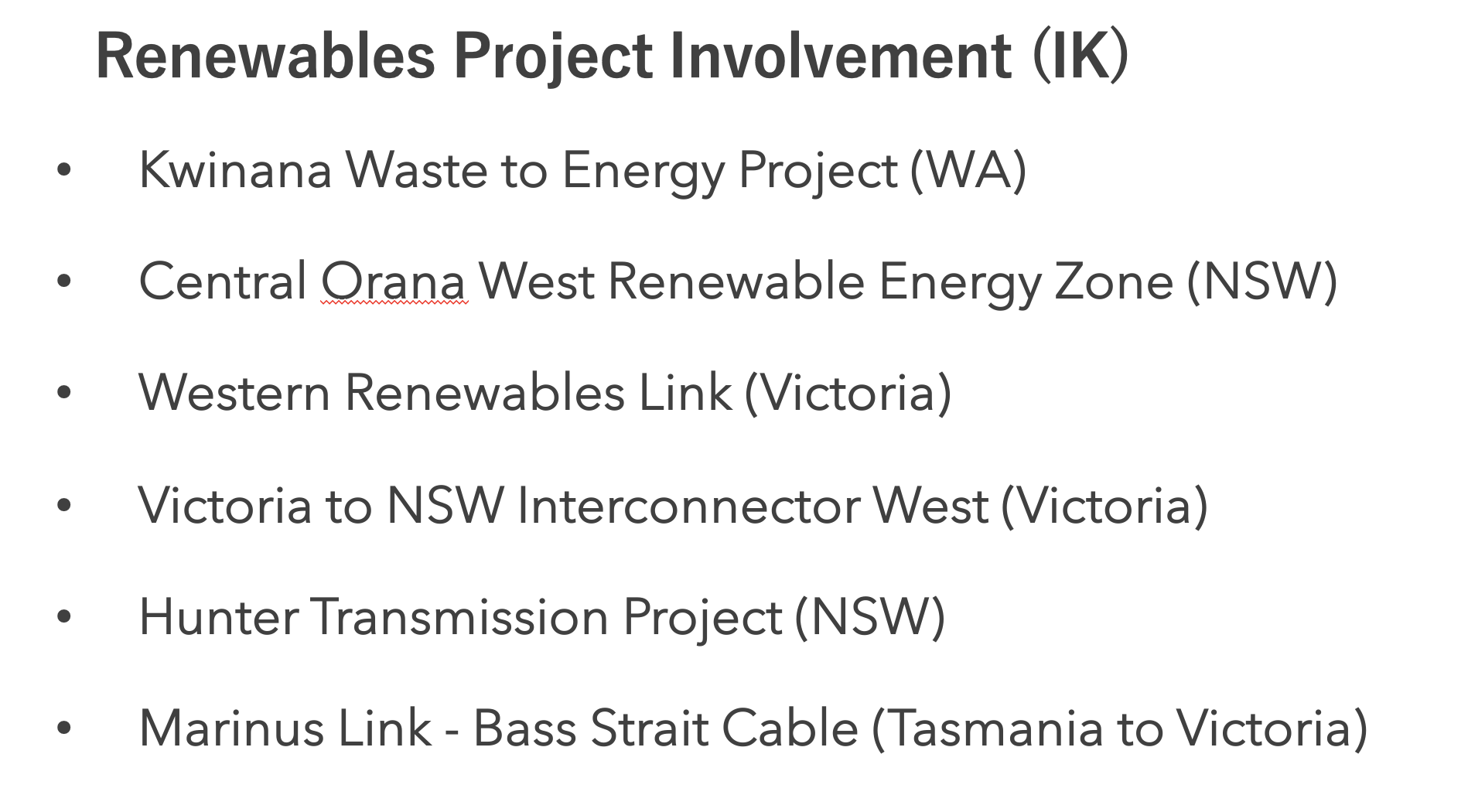
Australia is undergoing a significant transition to renewable energy, with numerous large-scale projects underway across multiple states, including Western Australia, New South Wales, Victoria, and Tasmania.

The centrepiece of the plan is the Optimal Development Plan, which includes a mix of replacement grid-scale generation, storage, and transmission, with an annualised capital cost of $122 billion projected to 2050. Individual project construction costs for major transmission projects typically range from $2 to $6 billion.

Ian cited AEMO’s role in managing the process and provided examples of key projects such as the Western Renewable Link, Victoria-NSW Interconnector West, Marinus Link, and Central West Orana Renewable Energy Zone. He also noted the unprecedented volume of simultaneous projects, drawing a parallel to the mining boom in terms of resource demand.

The challenges include resource constraints, skilled labor shortages, project complexity, lengthy environmental and property acquisition processes, and opposition from local communities. Ian highlighted the limited number of major construction companies—most of which are overseas-owned—and the strain this places on project delivery.

There is significant strain on resources and skilled labor due to the concurrent execution of many large projects, with a limited pool of experienced workers and companies.

The construction industry is dominated by overseas-owned firms, such as Holland and ASEAN, adding further complexity.

Environmental impact studies, property acquisition, and multiple approval processes are lengthy and can take months or years, causing delays.

Opposition from local communities and the complexity of land acquisition—especially for large transmission lines that cannot be easily rerouted—are major hurdles.


Ian provided detailed descriptions of project lengths, capacities, technical challenges, and their roles in the broader energy transition. He discussed the need for new transmission lines to reduce congestion and enable renewable integration, as well as the logistical challenges of constructing such infrastructure.


The 'Kwinana Waste to Energy' project is operational, generating over 38 MW for 55,000 homes, diverting up to 46,000 tonnes of waste from landfill, and reducing CO2 emissions equivalent to taking 85,000 cars off the road. It is currently the only operational waste-to-energy project in Australia.The Rockingham project, which Ian also worked on, has stalled due to technical problems and is not yet operational.

The April 2020 blackout in Spain and Portugal was discussed, its causes, and implications for Australia’s grid as renewable penetration increases. Ian described the event as one of the most extensive blackouts in European history, affecting 55 million people for over 10 hours. This was caused by a rapid drop in grid frequency and cascading failures, and emphasized the need for robust interconnection, digital monitoring, and system recovery protocols.

 The question of improving grid stability and resilience in Australia was also discussed as well as the role and future of emerging technologies such as hydrogen fuel cells and advanced energy storage.

Ian also discussed the potential role of nuclear and gas in Australia's future energy mix and the business case and economic justifications for large-scale projects, concluding with the main challenges in transitioning to new energy projects in Australia.

The full transcript of the  powerpoint slides and transcript of presentation can be found using the links below. 

 millpointrotaryclub.org.au>members only (password)> this link>Guest Speaker Presentations>KREMMER Ian - Renewables Rollout presentation

 millpointrotaryclub.org.au>members only (password)> this link>Guest Speaker Presentations>KREMMER Ian - Transcript of presentation 23 May 2025.


Directors' Reports and Member Announcements

David R: 

  • Reminder for June changeover lunch book now at www.trybooking.com/DBENN

Rick S: 

  • Community Services meeting at 8.30, introduce new members to "Unsung Hero's" event next week.

Michelle L: 

  • Margaret Hyatt is away so please RSVP to Michelle for breakfasts mmalovkis1@icloud.com.
  • New Youth Project "Literacy in lower economic schools"

It's a Fine(s) Line...

  • Put a coin in the middle if you have not heard of John Dalton*.
  • Another one if you don't know what achromatopsia** is.
  • Supporters of the two winning local AFL Teams last weekend - don't see that often!
  • Supporters of Roger Cook's defunct Syndey Bears Rugby team.
  • Fans of Rita's speedway through Burswood.
  • Mike Collet for Tottenham Hotspur win.
  • David Thomas and Peter Matthews - long time no see!
  • Brian Adams needing to prove he is over 65.
  • Ross Smith - our man in the mask.
  • Everyone at Table 2 (because I said so!) 

* Scientist who invented atomic theory in 1803. First person to realise he was colour blind.

** Colour blindness affects 1 in 12 males and 1 in 200 females  or about 4.4% of the population. See Wayne if you would like to know more or about celebrating Colour blindness day on 6 September.

Winner of Heads and Tails

4 lots of H & Ts followed by the winning two tails saw Ross Smith win the wine this week. Thanks to Margaret and Lyn Metcalf for supplying the grog each week.

Attendance

35 attendees in all, including guest speaker Ian Kremmer, visting Rotarian Bill Boekman and visitors Diane Allen and Anton Najjar.

Saturday, May 17, 2025

Bulletin #41

Induction

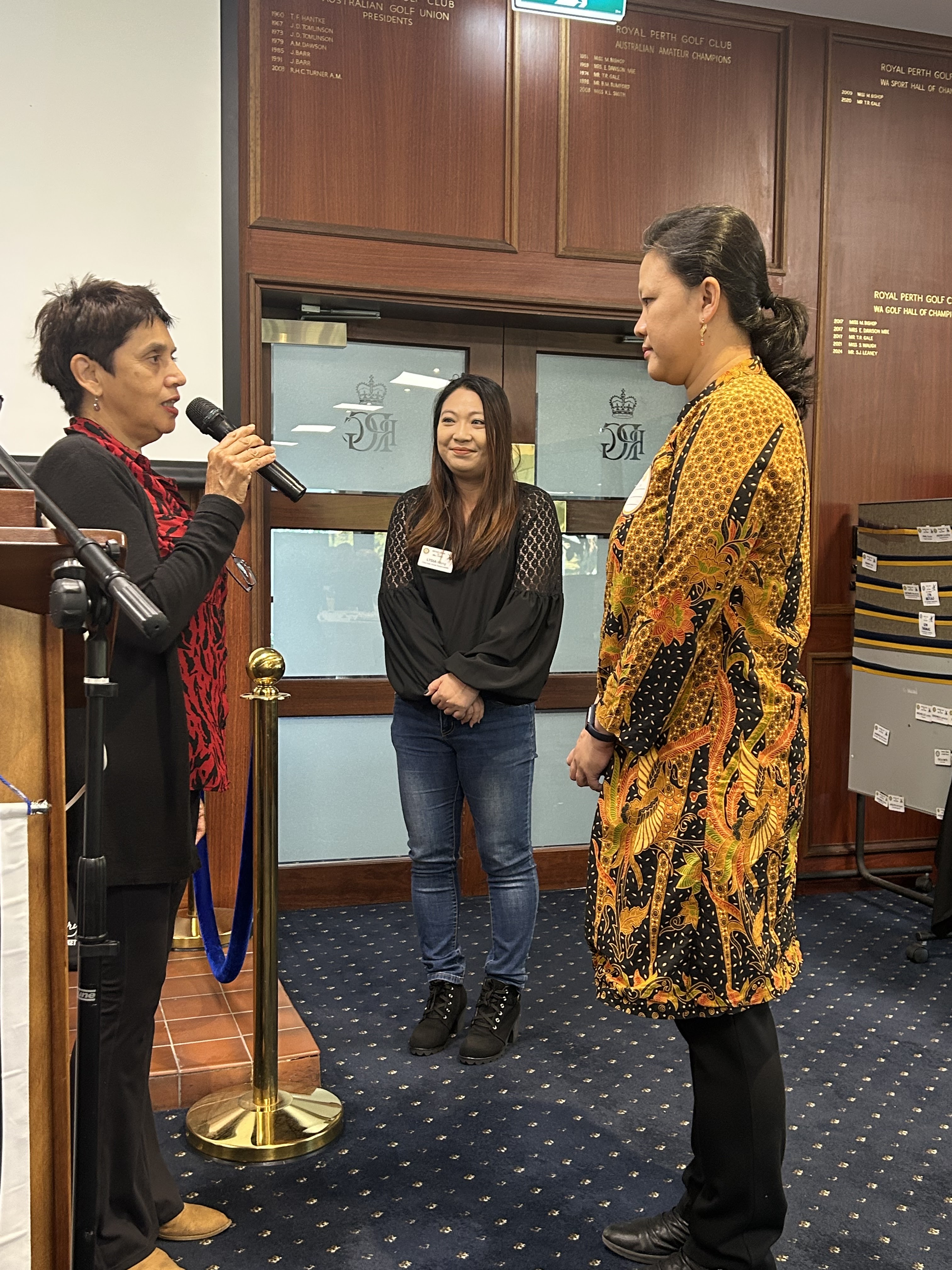
President Kelly welcomed Rotarian Alison Thair to conduct the induction of Dr Eunice Sari, our latest new member. Rotarian Lydia Wong introduced Eunice to the club:

“I met this amazing lady through Diana Goh. We went for a morning walk and I became one of Eunice's many fans. 

Dr Eunice Sari is a digital transformation expert and educator who helps businesses and students around the world create better tech experiences for real people. 

As CEO and co-founder of 'Customer Experience Insight' in Perth, she teaches companies how to design websites, apps, and services that are easy to use, helpful, and ready for the future with AI.

Her signature programs are Marginpreneur and DiversityInnovation -  that support migrants, women, and young people to build their own businesses, find jobs, and create positive change through technology.

This lady’s achievements are so vast that I am not done yet! 

Eunice is also the first woman in SEA to be certified as a Google Expert in Product Design and leads the Perth AI Innovators meetup. She’s mentored startup founders in global programs like Google for Startups and Women Techmakers, always bringing her passion for user-friendly design and inclusive innovation to the table.

Ok finally, time for a Fun fact now. 

Eunice can turn any boring workshop into party—with sticky notes, lots of laughter, and even some Indonesian snacks. 

Let us welcome Eunice to our Rotary family.  We are blessed to have a global thinker with a local heart, always ready to share big ideas over great food - preferably yummy Asian food and impactful conversations”.

Guest Speaker :Dr Jean Butler - the Early Years of Silver Chain.

Jean has a PhD in history and was the Director of the Centre for Western Australian History at UWA.


After leaving there, she worked for ten years at the State Library collecting archival material relating to West Australian history. A personal highlight during those years was walking 800 kilometres of the Camino trail from France to Santiago de Compostela in Spain. She retired from the library in 2021.


With a colleague, Deborah Gare, she was commissioned to write a centenary history of the Silver Chain. The book is called A Chain of Care, A History of the Silver Chain Nursing Association, 1905-2005.


Jean’s talk today - Care in the community – the early years of the Silver Chain is drawn from that book.


At the dawn of the 20th Century, what sort of care could you expect if you were sick in Perth or anywhere in the state and you were also poor? There was the Perth Public Hospital, the Home of Peace for the dying and incurable opened in 1903. But there was no Children’s Hospital until 1909 and no Women’s Hospital (“King Eddies”) until 1916. The community relied very heavily on women at home to care for the sick and elderly.


The population exploded due to the Gold Rush of the 1890’s and there was an outbreak of typhoid in Perth and the Goldfields during 1899. The Salvation Army, The St John of Gods Sisters and the Methodist Sisters of the People responded to this growing need. It could be argued that these Sisters were the forerunners of modern day district Nursing.


At the turn of the century WA had

many newspapers. The “Western Mail” and “West Australian” were to play a pivotal role in the Silver Chain. The West Australian had a “Children’s Corner” overseen by “Aunt Mary” journalist Muriel Chase. In 1904 she decided to turn the children’s readers into an organised club. She suggested they could all donate a shilling a year to help the distressed at Christmas or help the Sisters of the Church to establish a home at Parkerville for uncared-for babies. Aunt Mary added the new Society needed a name and decided on The Silver Chain League, the Silver reflecting the shillings and Chain being the children as links in the chain.


The first Silver Chain fundraising event was organised at Christmas 1905. Muriel Chase and her supporters knew that only those with really dire illness went to hospital, but help was very urgently needed for those that were seriously ill at home. A District Nurse going into a home could educate as well as nurse. District Nursing had been operational in South Australia since 1894. Aunt Mary in 1906 suggested they should pay for a District Nurse and buy a bicycle for her to be able to go from case to case. With barely enough money raised, in 1907 they employed Nurse Copley.


Aunt Mary advocated for the need for clean garments for babies, old clean linen for clothes and dressings. In 1908 Nurse Cherry was appointed and she stayed for 33 years. By 1909 the management of the District scheme had been taken over by an influential group of Perth citizens that included Muriel Chase. The West Australian newspaper continued to provide support. After a period of time a pony and trap was purchase as a means of transport.


In 1909 The Children’s Hospital was opened. Midwifery cases were urgent and in 1910 a Maternity Nurse, Nurse Tate, was employed by Silver Chain. The poor and aged were to become much more prevalent amongst the Silver Chain patients.


The Christmas Fairs remained a major source of Silver Chain funding. Alfred Carson became the Chairman. He would ensure nurses were always paid when funds were tight. Often, he would stroll through the Terrace telling people about the Silver Chain’s dilemma and taking the occasional “ten pounder”.


In 1919 the Spanish Flu swept through Fremantle and other Perth suburbs. Nurse Dixon-Smith would be warned by neighbours when she arrived at a house where someone had taken ill. Those were terrible days for her. Community support and respect for the Silver Chain nurses was strong and services were received from doctors and chemists often at no cost. Supplies of blankets, food, medicine and clothing was received from friends and supporters.


In 1920 a land grant from the State Government enabled the Silver Chain to open a cottage home for the elderly. By now, 15 years from its beginning, the League was now operating an effective District nursing system and has begun residential care. A third strand, Bush nursing, has also begun developing.


By the 1930s there were lean times, an increased demand for services and a decrease in private money. The Charities Commission (later Lotteries Commission) support and Government grants became necessary to pay the nurses salaries. Post-war, Henry Gregg took over as Chairman and served 13 years.


By 1944, the Bush Nursing Society had been fully integrated into Silver Chain. Where there was a hospital or doctor in a town, District Nursing was introduced. If there was no hospital or doctor, Silver Chain Bush Nursing centres were established. Bush nurses were particularly intrepid, sometimes even needing to be an amateur Vet…..

Jean related a number of stories of the resilience of Bush Nurses and the hardships they faced. They would often have to travel long distances over difficult country. There were often language difficulties with the many migrant workers.


By the 1950’s the transport had changed and there were 25 trained nurses. By 1961, Silver Chain Home Help was established, but conditions still remained appalling for some of their patients, often so bad that helpers would refuse to work in them.


In the post-war years the fundraising model had remained 1/3 Lotteries, 1/3 Government and 1/3 private fundraising. The well known “Flower Day” would continue to raise thousands of pounds. These parades through Perth would draw crowds rivalling those of Anzac Day and wartime processions.


In concluding, Jean said there was so much more about Silver Chain, these were just the early days. Much has changed and grown with the Silver Chain, which has now been in operation for well over one hundred years. Jean’s PowerPoint can be viewed at:

millpointrotaryclub.org.au>members only (password)> this link>Guest Speaker Presentations>BUTLER Jean – The History of Silver Chain

Directors' Reports and Member Announcements

Ross Sweeney: The 14th RC of Como Classic Car Show 2025 -  RC of Como would like some feedback. Questionnaire attached, please have some input. Please click on this link Survey to complete.

Gerry McG: Former member Alan Eggleston has passed away. Funeral details to be announced. Reprsentation from Mill Point requested.

Geoff L: A Cornucopia of Coins was found lurking in the Treasurer's briefcase - mostly foreign coins so if anyone knows of a charity who can use them please contact Geoff 0457 327 027

Wayne D: Endeavour Awards night now sold out. There is now a waiting list so if you cannot attend please let Wayne know 0417 459 622 

David R: REMINDER - Changeover lunch on Friday 27 June. Please book via the Trybooking site - trybooking.com/DBENN

Cutting it Fine(s)

Owen the Outstanding doled out the fines this morning....
  • David Rowell, 55 years of wedded bliss!
  • Firgins (Fine Virgins) - Eunice and Bassem.
  • Lydia - the most amazing introduction of Eunice!
  • Shoe Lace Shirkers - all those with slip-ons who can no longer bend to tied their shoe laces.
  • Fashionista's - affordable (and fineable) fashion wearers/followers.
  • Tracking App Tragics - only used to find the way home!
  • Como Club Refugees - Ross McSweeney visiting from Como, and our Owen who started off there but then defected to Mill Point.
  • Box Buyer Alison - 3rd grandchild who made her debut on Sunday.

Winner of Heads and Tails

A plethora of tosses which the editor missed due to not listening until  Scott Dwyer was announced the grabber of the grog!

Attendance

39 attendees in all, including guest speaker Dr Jean Butler, visitors Eugene and Maria De Lima, Diane Allen and  Rotarian Ross Sweeney.